AI chatbots can be a helpful space to write about your feelings and feel less alone at odd hours, but they are not grief therapy and cannot replace human support. Griefbots — apps that recreate a deceased person's voice or messages — provide comfort to some people but carry real risks of delaying healthy grief processing. Before using one, understand how they work, what research shows, and what legal rights apply to your loved one's digital likeness.
Grief doesn't follow a schedule. It shows up at 3 in the morning when you can't sleep, on a Tuesday afternoon when a familiar song comes on the radio, at a dinner table with one fewer person at it. The people you want most are sometimes the ones who are gone — and the people who are still here don't always know what to say. Some people have started turning to AI in those moments, either to write out their feelings or to try something more unusual: a conversation with a digital version of the person they lost. This guide explains what both of those experiences actually are, what they might help with, and where the real risks lie.
What a Regular Chatbot Can Help With (and What It Can't)
Writing about grief — putting feelings into words — is one of the things that genuinely helps, and decades of research on expressive writing support that. A general-purpose chatbot like ChatGPT or Claude gives you a place to do that anytime, without worrying about burdening a friend or waking someone up at midnight.
What a chatbot does well during grief:
- Gives you a space to write out whatever you're feeling at 3am, without judgment
- Asks gentle follow-up questions that help you say more than you might on your own
- Responds to "I'm having a really hard day" with warmth, at any hour
- Helps you draft a difficult message — to your children about what happened, or to a family member you've been avoiding
What it cannot do:
- Provide grief therapy or replace a trained counselor
- Know you, your history, or the person you lost
- Hold what you share in actual confidence (conversations may be visible to company staff or used for model training — check the app's privacy policy)
- Be there for you the way another human being can
A prompt that works well:
I'm grieving the loss of my mother/father/partner and I'm having trouble processing it. Can you just help me write out what I'm feeling right now?
The chatbot will follow your lead rather than trying to fix things too fast. That said: if your grief is severe — if you haven't eaten or slept for days, if you're having thoughts of harming yourself, or if you feel unable to function — an AI chatbot is not the right starting point. In the US, please call or text 988 (Suicide and Crisis Lifeline). You don't need to be in immediate danger to reach out.
What Are "Griefbots"? How Digital Replicas Work
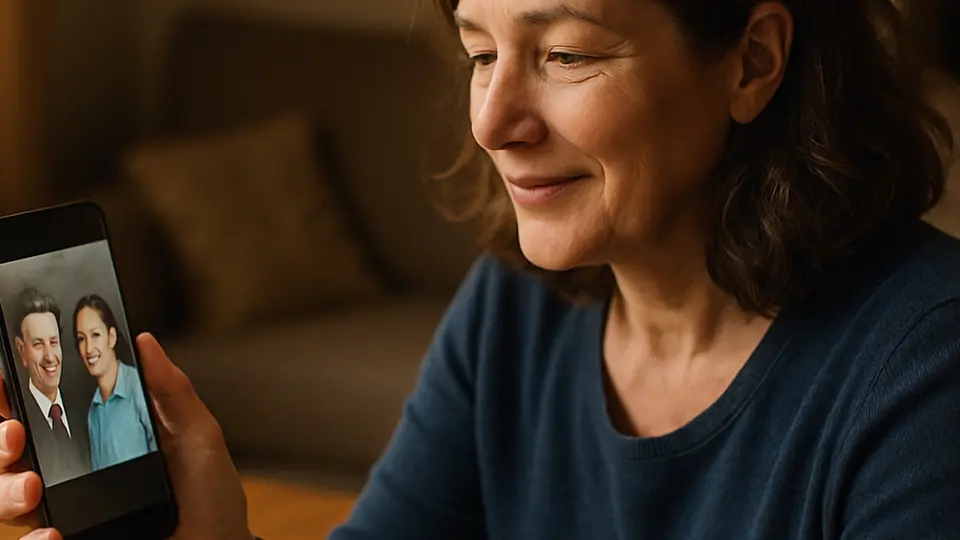
A griefbot is something different from a regular chatbot. Instead of a general-purpose AI, it's a system trained on data from a specific deceased person — their voice recordings, texts, emails, or social media posts — to simulate what it might be like to have a conversation with them after they're gone.
Two of the better-known services work like this:
HereAfter AI (hereafter.ai) is designed to be set up while someone is still alive. The person records voice conversations — stories, memories, answers to questions from family members — and the AI learns to respond in their voice. After the person dies, family members can ask questions and hear responses drawn from what was recorded.
You, Only Virtual builds a text-based replica using a deceased person's messages and social media posts. Family members can submit the data after someone has died.
Both create something that can sound or read like the person — responding to questions, sharing memories, using familiar phrases. But the underlying technology is pattern-matching: the system cannot know what the person didn't record, and it will sometimes say things they never would have said. Researchers who've studied griefbots have found roughly 70% accuracy in responses, meaning a meaningful portion of what the bot says contains errors, fabrications, or uncharacteristic phrases.
Why Some People Find Comfort — and Why the Research Is Complicated
A small qualitative study of 10 people who used digital replicas found that interacting with the replica offered a form of connection that human support sometimes couldn't fully provide. Specifically, people said it let them "talk" to the person they lost without worrying about burdening the living. That need — to say something to someone who is gone — is real and deep, and it doesn't disappear just because a person has died.
Scientific American covered the emerging field under the headline "Can AI Griefbots Help Us Heal?" and found genuine ambivalence among both users and researchers: some found real comfort, others found the experience unsettling or ultimately unhelpful.
But a 2026 study covered by TechXplore found that ongoing use of what researchers call "deadbots" can fuel pathological grief — a more prolonged and disabling form of mourning that doesn't naturally ease over time. Grief therapists warn that griefbots can extend the denial phase, making it harder to eventually reach acceptance. And because the bots achieve only partial accuracy, hearing a deceased parent say something out of character — because the bot got it wrong — can feel like a small but painful betrayal.
The research base is still very thin. No large controlled studies exist yet. What we have is a handful of small qualitative reports, a growing number of clinical warnings, and a wide range of individual experiences. That doesn't mean these tools are necessarily harmful, but it does mean going in with your eyes open.
Legal Rights and Consent: Who Controls a Digital Likeness?
The law is catching up with this technology, though slowly.
Washington state passed a law in June 2026 setting civil penalties of up to $3,000 per violation for creating unauthorized digital replicas of real people. The law applies to commercial uses of a person's likeness without their consent.
The NO FAKES Act, a federal US bill, is pending in Congress and would create nationwide standards for digital replicas of voice and likeness.
Outside the US, protections vary significantly. In most places there is currently no clear legal framework governing whether a family member can or cannot authorize a digital replica of a deceased person without that person's own prior consent.
Practically, this means:
- A reputable service will require documented consent — either from the person while they were alive, or from a next-of-kin with legal authority over the estate
- Services operating in legal gray areas may not ask for consent at all
- If a company approaches you unsolicited, offering to build a digital replica of someone you've lost, treat that as a red flag
Staying Connected to Real Human Support
AI works best as a supplement to human support, not a replacement for it. A few places to find genuine human connection during grief:
Hospice bereavement programs. If your loved one received hospice care, the hospice is typically required to offer bereavement support to the family for up to 13 months after the death — at no cost. Many people don't know this. Call the hospice that was involved and ask what's available. Hospice News reported in April 2026 that AI grief tools are presenting new complexities in bereavement care — and that clear guidelines around consent and data privacy are still lacking in this space (Hospice News, April 2026).
Grief support groups. In-person and online grief groups run by hospitals, hospices, and community centers are free or low-cost. Connecting with someone who has genuinely been through loss is a different experience from any AI interaction.
Grief therapists. Psychology Today's therapist finder (psychologytoday.com/us/therapists) lets you filter by specialty, insurance accepted, and location. Many grief therapists offer sliding-scale fees.
Crisis support. If you're in the US and struggling with thoughts of suicide or feeling overwhelmed, call or text 988 (Suicide and Crisis Lifeline). You don't have to be in immediate danger to call — if grief feels unmanageable, reaching out is the right move.
If a Company Offers to Build an AI Clone of Your Loved One
Whether the offer comes from a well-meaning family member or a commercial service, here are the questions to ask before you say yes:
- What data will be used? Voice recordings, texts, emails, social media? Who collects and stores it, and how is it protected?
- Who owns the output? Can you access the underlying data, export it, or request permanent deletion?
- What happens if the company closes? Is there a plan for what happens to the digital replica?
- Did the person ever express a wish about this? Anything written, recorded, or shared with someone you know?
- How will this affect others who loved them? Children, surviving parents, and siblings may feel very differently about a digital recreation.
There's no obligation to say yes — and no obligation to explain yourself if you say no.
How to Document Your Own Wishes
If you want to be proactive about what happens to your own digital likeness after you die, here's what you can do now:
Write it down. A clearly written statement — "I do/do not consent to a digital replica being created from my voice, texts, or social media" — added to your advance directives or will carries real weight. Make sure the executor of your estate knows it's there.
Create your own version while you're alive. Services like HereAfter AI are specifically designed for this: you record your voice, your stories, your answers to questions from family members, and the AI creates something your family can use after you're gone — with your full knowledge and consent.
Have the conversation. Whatever you decide, tell someone who will outlive you. A written document helps, but a real conversation is even better.
What to Try Next
If you're thinking more broadly about AI companionship for yourself or an older family member, AI Companions for Seniors: What They Can and Can't Replace covers that ground in depth. And before you share anything personal with any AI tool — especially during a vulnerable time — What You Should Never Tell an AI Chatbot is worth reading first.