This article is for general information only and is not medical advice. For any health concerns, please consult a qualified healthcare professional.
AI journaling apps are genuinely useful for guided reflection, mood tracking, and CBT-style coping techniques at any hour of the day or night. They are not a substitute for therapy, crisis support, or diagnosis. Reflectly and even plain ChatGPT can all serve as low-stakes journaling partners — as long as you know what they can and cannot do.
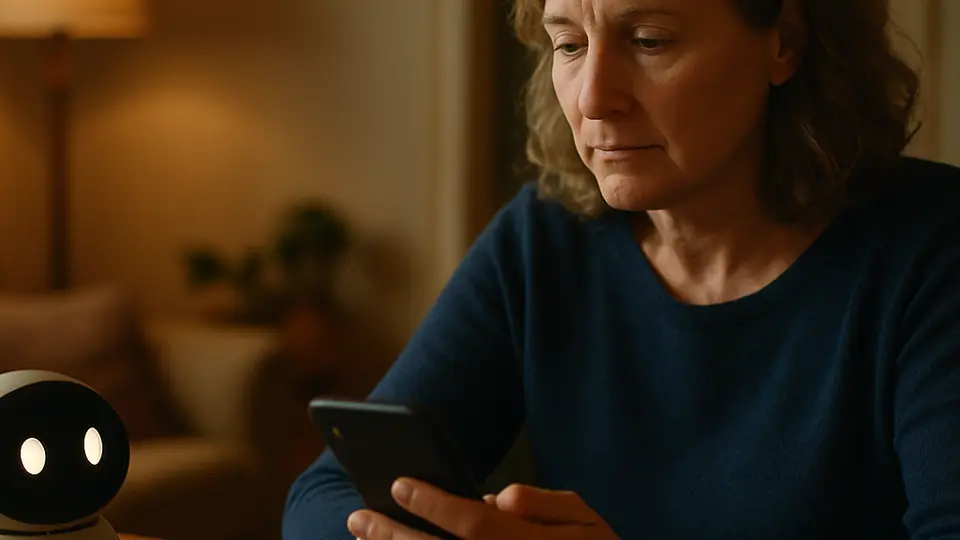
It is 3am and your mind will not stop. You have tried reading, you have tried breathing, and now you are staring at your phone wondering whether to write down whatever is chasing you. An AI journaling app is not a therapist — but it is awake, it will not judge you, and it might help you get what is spinning in your head onto a page and into perspective.
That is what these apps are built for: not to replace professional care, but to give you a low-barrier way to process stress, notice patterns in your mood, and learn a few practical coping techniques. Here is what they genuinely offer, where they fall short, and how to use them without making the common mistakes.
What AI Journaling Apps Actually Do
The useful ones do a few specific things well.
Prompted reflection. Instead of staring at a blank page, you get a question: "What's one thing that felt heavy today, and what made it feel that way?" That structure makes it easier to start — and the process of answering, even imperfectly, often helps more than the answer itself.
Mood tracking. Most apps ask you to rate how you are feeling, tag what was going on, and log this over time. After a few weeks, patterns become visible that are invisible when everything lives inside your head. You might notice you are consistently lower on Sunday evenings, or that the same kinds of situations keep showing up on hard days.
CBT-style exercises. Cognitive behavioral therapy is a well-researched approach that examines the connection between your thoughts, feelings, and behaviors. Several AI apps translate core CBT techniques into short guided conversations — things like spotting catastrophic thinking, questioning the evidence behind a worry, or identifying small actions you could take. These are not a replacement for CBT with a trained therapist, but they are useful tools you can reach for at any hour.
Something to talk to at 3am. This is not nothing. A lot of the value people describe from these apps is not any specific technique — it is simply having a patient, non-judgmental space to say what is going on, without waking anyone up or worrying about what they will think.
These apps work best for ordinary day-to-day stress: work pressure, relationship friction, sleep troubles, low-grade worry. If you are looking for apps designed specifically for social connection and loneliness rather than stress management, AI Companion Apps for Seniors covers that related category.
The Apps People Use Most
Woebot (woebot.io) was one of the best-known mental-wellness chatbots, built by clinical psychologists and using CBT and DBT techniques to guide structured conversations. It shut down its consumer app on June 30, 2025 and is no longer available to individual users. The company now operates exclusively as an enterprise platform for healthcare organisations and employers. For a free alternative with a similar approach, plain ChatGPT can guide structured conversations at no cost.
Reflectly is a guided journaling app with AI-personalized prompts. It costs around $9.99 per month on iOS (pricing varies by platform). More journal-like than a chatbot approach: you write, and the app follows up with questions. It includes mood tracking over time.
Day One is a well-established journaling app that has added AI features to help you write, reflect on the day, and find patterns in older entries. It is not primarily a mental-wellness app, but many people use it that way.
Using Plain ChatGPT as a Journaling Partner
You do not need a dedicated app. ChatGPT and similar AI assistants can serve as an on-demand journaling partner, available any time, capable of going deeper on whatever you bring up. The difference is that you drive the session yourself — there are no daily prompts, no mood tracker, and no history that carries over between conversations unless you save it.
Prompts you can copy and use right now:
"I'm feeling anxious about situation. Help me work through this using CBT — ask me to examine the evidence for and against my worry, and suggest what I might tell a friend in the same situation."
"I've been feeling stressed lately but I can't quite name why. Ask me some questions to help me figure out what's actually going on."
"Walk me through a short breathing or grounding exercise. I'm feeling overwhelmed right now."
"I want to do a brief mood check-in. Ask me three questions about how I'm feeling and what's going on, then give me a short reflection and one small thing I could try today."
One thing worth knowing: ChatGPT is designed to respond carefully when you describe significant distress. It will suggest professional help if what you describe sounds like a crisis — which is the right response, not a limitation.
What to Watch Out For
Privacy matters more than you might think. These apps ask you to share things you would not tell most people. That information lives on someone else's servers. Before you start, take five minutes to read the privacy policy: does the company share your data with third parties? Can they use your entries to train future AI models? How do they handle law enforcement requests? For a fuller look at what to keep private, What Not to Tell an AI Chatbot is a short, practical read.
A useful rule of thumb: treat AI journal entries the way you would treat a public diary. Anything you would not want a stranger to read — crisis thoughts, relationship details, identifying information about other people — keep off the app.
AI is not a diagnosis. These apps can reflect your feelings back to you and teach you useful techniques. They cannot tell you whether what you are experiencing is generalized anxiety disorder, depression, OCD, or something else with a clinical name. If you are wondering whether what you feel has a diagnosis, that conversation belongs with a professional.
The app does not know what it does not know. A skilled therapist notices when you are avoiding something, reads between the lines, and remembers what you said three months ago. An AI journaling tool does none of these things — unless the app specifically builds in long-term memory, which most do not. Useful daily tool; not a replacement for care that adapts to you over time.
Substituting instead of supplementing. The main risk with AI wellness apps is not that they cause harm — it is that they can make someone feel like they are doing something about their mental health while the underlying issue goes unaddressed. Use these apps for daily habits and ordinary stress. Do not use them instead of getting professional help when you genuinely need it.
When to Reach for a Human Instead
An AI journaling app is a reasonable tool for processing everyday stress. It is not the right tool when:
- Your anxiety or low mood has been affecting your sleep, work, or relationships for more than two weeks
- You are having thoughts of harming yourself or others
- You are using alcohol or substances to manage how you are feeling
- You do not feel like you can keep yourself safe
In the US, call or text 988. The 988 Suicide and Crisis Lifeline is available 24 hours a day, seven days a week — not only for people who are suicidal, but for anyone in serious emotional distress. If you are outside the US, a quick web search for "your country crisis line" will find a local number. Most countries have one, and most are free.
A crisis line is not a failure. It is the right tool for a different kind of moment.
A 2025 systematic review and meta-analysis published in JMIR found significant short-term reductions in anxiety and depression symptoms across clinical trials of AI mental-health chatbots — encouraging evidence that these tools can help with genuine distress, not just mild stress. The same research, and a parallel analysis in the Hastings Center Report, also noted that independent oversight of these apps is still catching up to how widely they are being used. Using them thoughtfully, and knowing their limits, is something each person has to decide for themselves.
What to Try Next
If loneliness is part of what you are navigating, AI Companion Apps for Seniors covers a related category of tools built for social connection — worth reading to understand how the two kinds of apps overlap and differ. Before you start sharing personal details with any AI, What Not to Tell an AI Chatbot has a short, practical list of what belongs off the record.